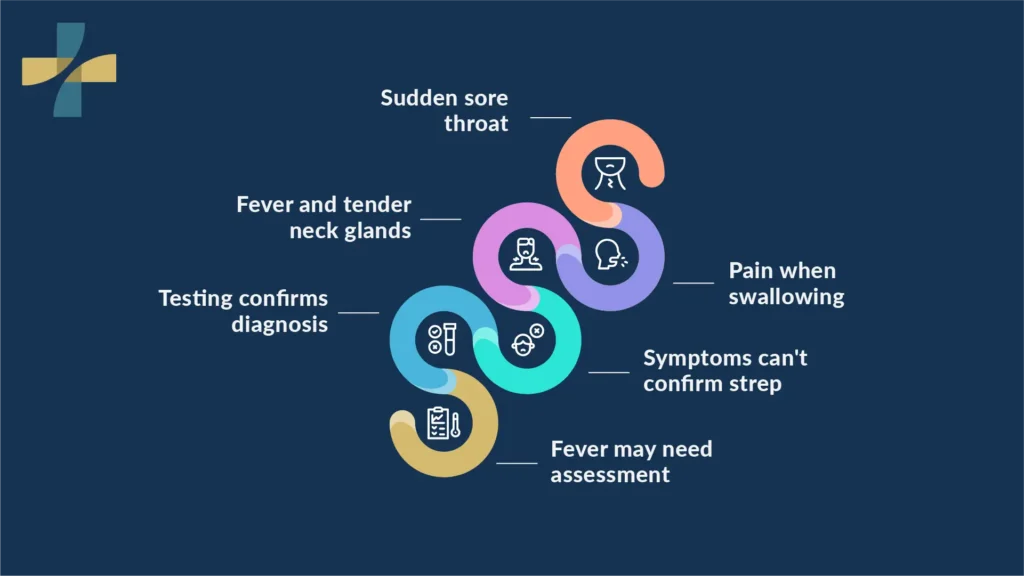
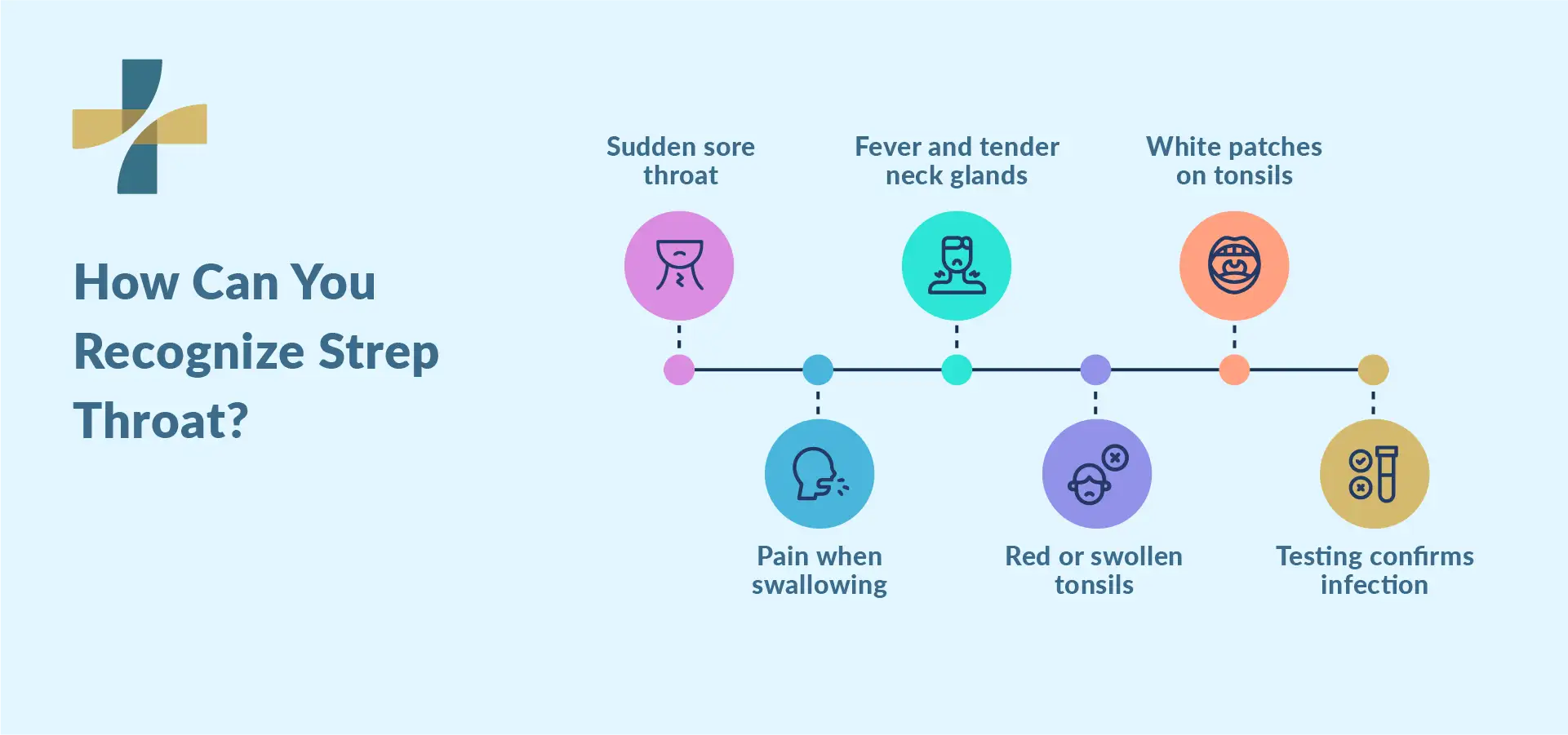
Strep throat symptoms may include a sore throat that begins suddenly, pain when swallowing, fever, tender neck glands, red or swollen tonsils, and white patches on the tonsils. However, symptoms alone cannot confirm strep throat because viral infections can cause similar signs.
Strep throat is an infection of the throat and tonsils caused by group A Streptococcus bacteria. Viruses cause most sore throats. According to the Centers for Disease Control and Prevention, around 3 in 10 children and 1 in 10 adults with a sore throat have strep throat.
A healthcare provider may recommend a rapid antigen test, throat culture, or another approved diagnostic test based on your symptoms, age, exposure history, and examination. Appropriate treatment for confirmed strep throat can reduce transmission, shorten symptoms, and lower the risk of some complications.
If you have a sore throat with fever, a medical assessment can help determine whether testing or another form of care may be appropriate.
What Are the Most Common Strep Throat Symptoms?
Common strep throat symptoms include sudden throat pain, painful swallowing, fever, tender lymph nodes at the front of the neck, and red or swollen tonsils. Some people develop white patches or streaks of pus on their tonsils. Children may also have headaches, stomach pain, nausea, or vomiting.
Symptoms usually develop about two to five days after exposure to group A strep bacteria. The infection is most common among children aged 5 to 15, but adults can also develop it, particularly when they have regular contact with school-aged children or people in crowded settings.
Sore throat, fever, swollen lymph nodes, and tonsil changes
Possible symptoms and examination findings include:
- A sore throat that begins quickly
- Pain when swallowing
- Fever
- Red and swollen tonsils
- White patches or streaks of pus on the tonsils
- Tiny red spots on the roof of the mouth
- Tender or swollen lymph nodes at the front of the neck
- Headache
- Body aches
- Reduced appetite
- Stomach pain, nausea, or vomiting, particularly in children
- A rough, red rash associated with scarlet fever
These symptoms are consistent with guidance from the CDC’s clinical overview of group A strep pharyngitis and the Public Health Agency of Canada.
Strep throat does not usually cause a cough, runny nose, hoarse voice, mouth ulcers, or conjunctivitis. These symptoms are more suggestive of a viral infection. Still, the absence of a cough does not prove that a person has strep throat.
The combination of sudden throat pain, fever, tender neck glands, and tonsil changes may raise clinical suspicion, but a healthcare provider generally needs a diagnostic test to confirm group A strep when clear viral symptoms are absent.
Strep Throat vs Sore Throat: Key Differences
Strep throat is one possible cause of a sore throat. Most sore throats are caused by viruses, and symptoms often overlap. Cough, runny nose, hoarseness, conjunctivitis, and mouth ulcers point more strongly toward a viral infection, while sudden throat pain, fever, tender neck glands, and tonsil exudate may increase suspicion of strep.
The comparison below can help readers understand common patterns, but it should not be used for self-diagnosis.
| Feature | Possible Strep Throat | Viral Sore Throat |
| Onset | Often sudden | May be gradual |
| Throat pain | May be moderate or severe | Can range from mild to severe |
| Fever | Common but not always present | May or may not occur |
| Cough | Usually absent | Common |
| Runny nose | Usually absent | Common |
| Hoarseness | Less typical | More common |
| Tender neck glands | May occur | May occur |
| Red or swollen tonsils | May occur | May also occur |
| White tonsil patches | May occur | Can occur with other infections |
| Testing | May require a throat swab | Depends on the suspected cause |
| Antibiotics | Used for confirmed group A strep | Do not treat viral infections |
Healthcare providers may use clinical scoring systems to decide who is likely to benefit from testing. These tools consider factors such as fever, tender neck glands, tonsil findings, age, and the absence of cough. However, the Infectious Diseases Society of America notes that clinical findings alone may not reliably distinguish group A strep from other causes when obvious viral symptoms are absent.
Do not start antibiotics based only on throat appearance or symptoms. White patches can occur with other conditions, including viral infections and mononucleosis.
When Should You Get a Rapid Strep Test?
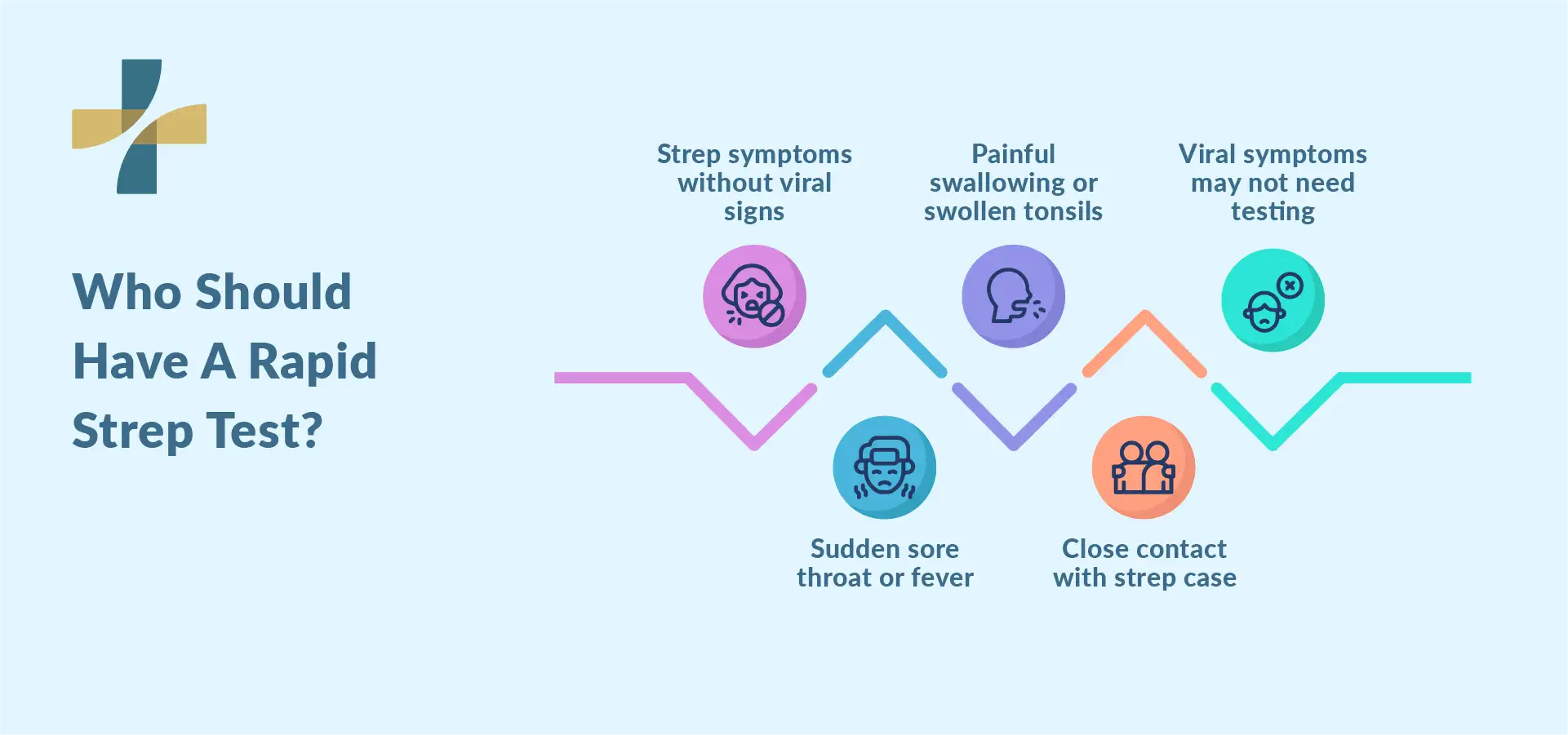
A healthcare provider may recommend a rapid strep test when symptoms suggest possible group A strep and there are no clear signs of a viral infection. Symptoms alone cannot confirm strep throat, so testing helps prevent both missed infections and unnecessary antibiotic use.
Routine clinician assessment and possible testing may be appropriate when you or your child has:
- A sore throat that begins suddenly
- Fever with throat pain
- Pain when swallowing
- Tender glands at the front of the neck
- Red or swollen tonsils
- White patches or pus on the tonsils
- A rough, sandpaper-like rash
- Recent close contact with someone who has confirmed strep throat
- Persistent or worsening throat symptoms without clear cold symptoms
People with cough, runny nose, hoarseness, conjunctivitis, or mouth ulcers are more likely to have a viral illness and may not need group A strep testing. The final decision depends on the healthcare provider’s assessment.
How rapid tests and throat cultures differ
A rapid antigen detection test uses a throat swab and can provide results relatively quickly. These tests are highly specific, but their sensitivity varies. This means a positive result can confirm group A strep, but a negative rapid test may occasionally miss an infection.
A throat culture takes longer because the laboratory must wait to see whether the group A strep bacteria grow from the sample. The CDC identifies throat culture as the gold-standard diagnostic test.
Follow-up after a negative rapid test depends partly on age:
- Children and adolescents: A negative rapid antigen test may need to be followed by a throat culture. This is especially relevant for symptomatic children aged 3 years or older.
- Adults: A back-up throat culture after a negative rapid test is usually not required because acute rheumatic fever is rare in adults.
- Positive rapid test: A positive rapid antigen test generally confirms group A strep and does not require a back-up culture.
The CDC’s patient testing guidance provides the same distinction between testing in children, teenagers, and adults.
Testing should not delay emergency assessment. Difficulty breathing, inability to swallow saliva, excessive drooling, severe dehydration, major neck swelling, or altered awareness require urgent medical attention rather than a routine test booking.
To ask about a rapid strep test appointment or the appropriate testing pathway, contact NV Med Center. Test availability should be confirmed when arranging your visit.
How Doctors Treat Strep Throat Symptoms
Healthcare providers prescribe antibiotics when a rapid antigen test, throat culture, or another accepted test confirms group A strep. Antibiotics are not recommended for viral sore throats because they do not treat viruses and can cause unnecessary side effects.
According to the CDC’s clinical guidance, antibiotic treatment for confirmed group A strep can:
- Shorten the duration of symptoms
- Reduce transmission to close contacts
- Lower the risk of some complications
Penicillin and amoxicillin are commonly recommended first-line treatments. A healthcare provider may select a different medication for someone with a penicillin allergy or another relevant medical consideration.
The medication, dose, and treatment duration depend on the prescription. Patients should take antibiotics exactly as directed and complete the prescribed course unless the treating healthcare provider gives different instructions.
Antibiotics reduce the risk of acute rheumatic fever in children with confirmed strep throat. However, treatment should not be described as preventing every possible post-streptococcal complication. Post-streptococcal glomerulonephritis, for example, is caused by an immune response and may occur after the original infection has resolved.
Managing pain and fever
Supportive care may make symptoms easier to manage while the infection improves. Depending on age and medical history, a healthcare provider may recommend:
- Drinking water, broth, or other fluids
- Eating soft foods that are easier to swallow
- Resting
- Gargling with warm salt water, when age-appropriate
- Using a cool-mist humidifier
- Using acetaminophen or ibuprofen as directed
- Using age-appropriate throat lozenges or ice chips
Do not give aspirin to children or teenagers unless a qualified healthcare professional has specifically advised it.
Contact the prescribing healthcare provider if symptoms are not beginning to improve after about 48 hours of antibiotic treatment, if symptoms worsen, or if new symptoms develop. Improvement varies, so patients should not rely on a guaranteed recovery date.
When can someone return to school or work?
A person with confirmed strep throat should remain home until both of the following conditions are met:
- They no longer have a fever.
- They have completed the clinician-recommended minimum period after starting appropriate antibiotics.
The CDC advises staying home until fever-free and at least 12 to 24 hours after beginning appropriate antibiotic therapy. Local school, childcare, workplace, or public-health policies may use a specific minimum period, so follow the instructions provided by your healthcare professional.
Handwashing, covering coughs and sneezes, and avoiding shared cups, utensils, and food can also reduce transmission.
When Strep Throat Symptoms Need Medical Care
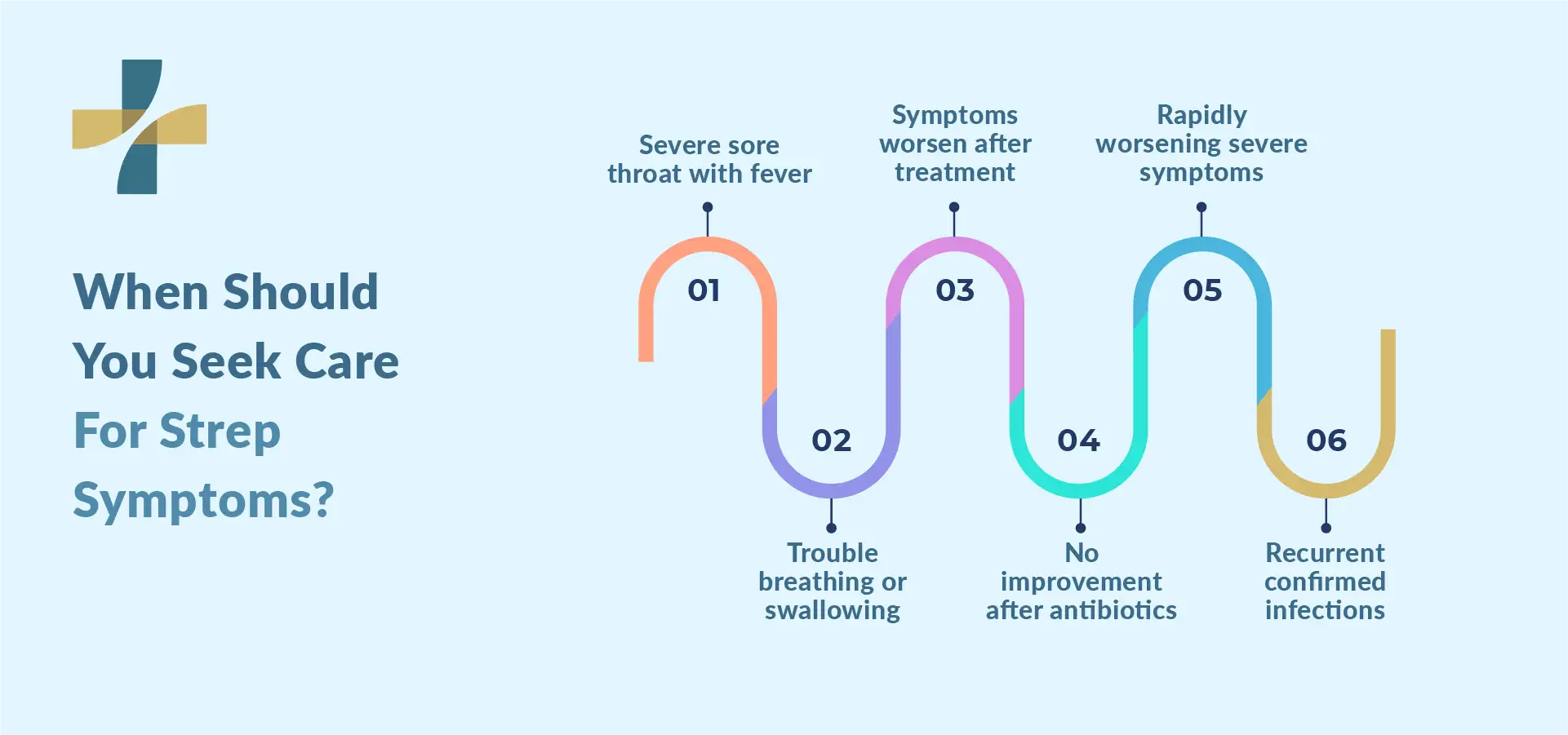
Arrange a healthcare assessment when a sore throat is severe, occurs with fever, does not begin improving, or is accompanied by symptoms that may require testing. Young children, people with weakened immune systems, and people with recurrent confirmed infections may need more specific guidance.
Seek urgent or emergency medical care for:
- Difficulty breathing
- Inability to swallow saliva
- Excessive drooling
- Severe or rapidly increasing neck swelling
- Signs of severe dehydration, such as very little urine, marked dizziness, or unusual drowsiness
- Confusion, reduced responsiveness, or altered mental status
- Blue or grey lips or skin
- Severe weakness
- A rapidly spreading rash with serious illness
- Severe symptoms that are worsening quickly
These symptoms should not be managed as a routine rapid-test appointment. They may indicate airway obstruction, a deep neck infection, severe dehydration, or another condition requiring immediate assessment.
Contact a healthcare provider promptly if:
- Symptoms worsen after starting treatment
- Fever returns
- Throat pain becomes more severe on one side
- The voice becomes muffled
- It becomes difficult to open the mouth
- New ear pain develops
- Urine becomes dark or urine output decreases
- Swelling develops around the eyes, hands, or feet
- A sandpaper-like rash appears
- Symptoms do not begin improving after approximately 48 hours of prescribed antibiotics
Group A strep can rarely lead to complications such as peritonsillar abscess, retropharyngeal abscess, cervical lymphadenitis, acute rheumatic fever, or post-streptococcal glomerulonephritis. The CDC describes these complications as uncommon but potentially serious.
A rough rash that feels like sandpaper may be a sign of scarlet fever. The Public Health Agency of Canada lists sore throat, fever, swollen neck glands, and a sandpaper-like rash among its common signs.
People who experience recurrent, test-confirmed strep infections should discuss their pattern of illness with their healthcare provider. Routine screening or preventive antibiotic treatment of every household member is not recommended for each case. People who carry group A strep without symptoms generally do not need antibiotics, according to the CDC’s testing guidance.
To see a doctor for a sore throat, arrange an assessment rather than relying on symptoms alone.
How NV Med Center Can Help With Sore Throat Assessment
NV Med Center can assess sore throat symptoms, review your medical history, examine your throat and neck, and advise you on suitable next steps. Depending on the clinical assessment and currently available services, this may include testing, treatment for a confirmed infection, supportive-care advice, follow-up, or referral to another facility.
Because testing methods and availability can change, confirm whether rapid antigen testing or throat culture collection is available when booking.
During an assessment, the healthcare provider may consider:
- When the symptoms started
- Whether fever is present
- Whether you have a cough or runny nose
- Whether you have had close contact with a confirmed case
- Your age and medical history
- The appearance of your throat and tonsils
- Whether the lymph nodes in your neck are tender or swollen
- Whether testing or urgent referral is appropriate
Conclusion
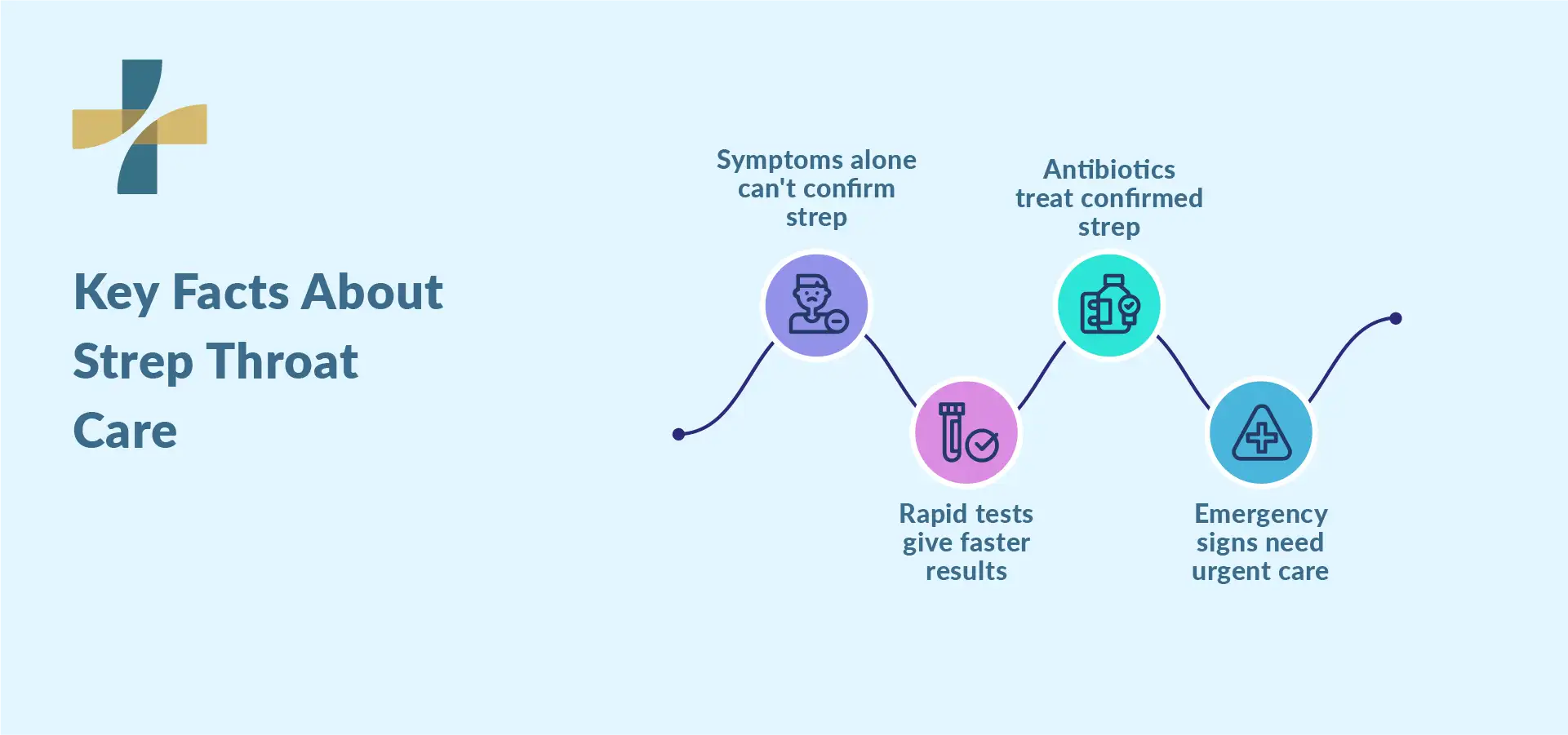
Strep throat symptoms often include sudden throat pain, fever, painful swallowing, swollen neck glands, red tonsils, and white patches on the tonsils. However, these symptoms can overlap with viral infections, so they cannot confirm strep throat on their own.
A healthcare provider may recommend a rapid antigen test, throat culture, or another accepted diagnostic test. A throat culture remains the diagnostic gold standard, while rapid tests are commonly used because they can provide results more quickly. Negative rapid tests in children and adolescents may require a follow-up throat culture, while this is usually not necessary for adults.
Confirmed strep throat is treated with prescribed antibiotics. Appropriate treatment can shorten symptoms, reduce transmission, and lower the risk of some complications. Patients should follow their clinician’s instructions and remain home until they are fever-free and have completed the recommended minimum period after starting appropriate antibiotics.
Experiencing a severe sore throat, fever, or painful swallowing? Contact NV Med Center to arrange a sore throat assessment and ask about the appropriate testing pathway. Seek urgent or emergency care instead if you have trouble breathing, cannot swallow saliva, show signs of severe dehydration, or have rapidly worsening symptoms.
FAQs
What are the first symptoms of strep throat?
The first symptoms may include a sore throat that starts suddenly, pain when swallowing, and fever. Tender glands at the front of the neck, red or swollen tonsils, white tonsil patches, headache, or stomach symptoms may follow. Symptoms alone cannot confirm strep throat, so testing may be needed.
How can I tell strep throat from a regular sore throat?
Strep throat is more likely to begin suddenly and may occur with fever, tender neck glands, and red or swollen tonsils. A cough, runny nose, hoarseness, conjunctivitis, or mouth ulcers more strongly suggest a virus. Because symptoms overlap, a throat swab may be needed for confirmation.
Do strep throat symptoms always include a fever?
No. Fever is common but is not present in every case. A person can have confirmed strep throat without a fever. Conversely, fever and throat pain can also occur with viral infections, so the presence or absence of fever cannot confirm or rule out strep throat.
When should I get tested for strep throat symptoms?
Ask a healthcare provider about testing when you have sudden throat pain, painful swallowing, fever, tender neck glands, tonsil swelling, white tonsil patches, a scarlet-fever-like rash, or recent exposure to a confirmed case without clear viral symptoms. The clinician will decide whether a rapid test, throat culture, or another test is appropriate.
Can strep throat symptoms go away without antibiotics?
Symptoms can sometimes improve without treatment, but confirmed group A strep is generally treated with antibiotics. Treatment can shorten symptoms, reduce transmission, and lower the risk of some complications. Do not take antibiotics unless strep throat has been confirmed and the medication has been prescribed for you.
When are strep throat symptoms urgent?
Seek urgent or emergency care for difficulty breathing, inability to swallow saliva, excessive drooling, severe dehydration, rapidly increasing neck swelling, blue or grey lips, confusion, reduced responsiveness, or rapidly worsening illness. These signs require more than a routine strep test appointment.